Showing posts with label Ed Beavan. Show all posts

Thursday, 31 October 2013

India: Going Back in Time

Going Back in Time

My Swatch watch recently stopped. Yes, I know I'm probably a bit too old to have a Swatch, but I got attached to them during my teenage years and have had them ever since. Anyway, I was a bit gutted when it stopped the other day.

But the great thing about living in India is that everything is repaired or recycled. Not like in the West, where we just throw out a toaster or TV when it's broken and buy a new one. Here repair men still do a thriving trade, and most things are repaired or recycled, often in ingenious ways.

So I confidently took my Swatch to the watch repair man in the bazaar (see photos below). For some reason he sits in a little perspex box in a TV repair shop. Anyway, after about 20 minutes he returned my repaired watch for the princely sum of just 100 rupees (about one pound). I was delighted, my pride and joy had been restored!

Unfortunately my joy was shortlived. The next day strange things started to happen. My watch started going backwards, with the second hand going anti-clockwise. Then bizzarely, the actual watch face started to rotate backwards, with the numbers completely out of place. My watch was literally going back in time.

Sadly, this was the end of the road for this Swatch, and I ventured back to the bazaar and bought a flashy (fake) Emporio Armani watch, which will no doubt break soon.

But the moral of the story remains: re-use and recycle if you can.

The watch repair man destroying my Swatch

"I'm a living in a box": Watch repair guy's base

The box and the road at Landour bazaar

Here Comes the Sun (Nahi)

October is supposed to a gloriously beautiful month here in Mussoorie, with constant sunshine and views of the snow-capped Himalayan peaks. Visitors and alumni of the school flock back at this time to enjoy the Indian alpine experience.

Except this year it has just not happened. Monsoon went on interminably, from the 1 June to about last week. Then we had a few nice sunny days, and now the really cold weather has come in.

We have gone from Monsoon to Winter, without the sunny bit in between! It kinda sucks, as my American colleagues would say. Maybe it's a one-off, maybe it's down to changing climate conditions which have seen strange weather patterns everywhere.

The one positive is that we are getting a new, super-duper bukari (wood stove) soon, so that should keep us warm in this particularly cold Winter. It's due to arrive in the next six to seven days (not 67 days as I first understood!), so I'll blog about that next time.


A local man shelling beans by treading on them
Going Back in Time 2: A Week in a Himalayan Village


It was recently Activity Week at Woodstock, when the whole school has a week off classes and goes out into various parts of India for an outdoor education experience.

This year I accompanied a group of 15 Grade 9 (14/15-year-olds) students to a village in the Aglar River Valley, about a three hour drive from here.

Before we went, there were the expected moans from kids asking how they would survive away from the internet, computer games and TV for seven whole days. I, on the other hand, was rather looking forward to it.

Corn drying by a house
Our village was called Gaird, and staying there was a wonderful experience. Away from the distractions and obsession with modern technology, we taught at the local schools, helped the villagers harvest and shell their beans and chillies, tried our hand at ploughing with oxen, hiked in the surrounding hills and frolicked in the Aglar River for a day.

We were reminded how we take our food for granted and appreciated how hard some people have to work to get food on the table. Many of the villagers lost land in the recent severe rains in Uttarakhand.

We built up friendships with the villagers, were given the tastiest Indian khanna every day, and learnt to just enjoy having time to "be", not rushing around checking our mobile phones every two minutes.

Gaird village from above
We were the centre of attention for the village kids, and we also enjoyed demonstrations of local Garhwali dancing from the children, games of tug of war, arm wrestling and kabbadi with the guys.

By the end of it, even the kids agreed it was great to "go back in time" in a sense and experience a more simple way of life, where people who have much less materially yet seem in many ways a lot more content than those of us who are comparatively richer.

By the end of the week, we had all gone for seven days without the internet and a mobile phone, and guess what, the world didn't end!

Below are some photos of the week:

From generation to generation: Grandfather and grandson
On the pull: Tug of war
Just bought a yoke of oxen, trying them out!
View from above: local kids look down on the Woodstock kids
Buffalo Stance: Water bovine
Traditional Garhwali house with wooden arches
Our Woodstock group


Wednesday, 19 December 2012

Absolutely bilkul: A year in India: Mussoorie, Modernisation and Movember


Absolutely bilkul: A year in India

Howdidy Doodily folks! Apologies for the radio silence on this blog for a while, it was a crazy last few weeks of semester, but now school is out things have calmed down a lot.

It’s lovely being up here just chilling in the run up to Christmas, enjoying the mountain environment and spending quality time with Kirsten. We were even able to sit out and sunbathe whilst reading this afternoon. It’s boiling hot in the winter sun, but when the sun goes in it’s freezing. We’ve also been enjoying the stunning sunsets from our house…the photo here does not really do it justice but hopefully gives you a flavour.

The view from our sofa at sunset, they have been stunning recently. PHOTO: KIRSTEN BEAVAN

So, unbelievably, we’ve almost completed our first year of marriage and of living in India together. It has flown by but as I said in the title, it’s been absolutely bilkul. For those of you without knowledge of Hindi, I should say bilkul means absolutely. Why then, you might ask, am I using this tautology: absolutely absolutely?

It all stems back to a funny story when I was in Delhi. I had learnt the Hindi expression, bilkul pagal, which means absolutely crazy, and tried to level it at a taxi driver who had sped me across Delhi like a madman before demanding an extra 200 rupees from the price agreed. Attempting to express my dissatisfaction during our altercation, I told him I thought he was absolutely bilkul. Needless to say my wife and Hindi speaking family members found this mistake hysterical, and now the expression has become common parlance in our household.

Mussoorie

I realise I have not written much about the town where we live and where Woodstock is located. Mussoorie is 175 miles north of Delhi in the foothills of the Himalaya, in the state of Uttarakhand (literally mountain region). It is about 7,000 feet up and nicknamed “Queen of the Hills”, and is a hill station where people come up to escape the heat of the plains. During the days of the Raj British soldiers came to convalesce. Local author and Woodstock alumnus Steve Alter has written an excellent piece about Mussoorie and its link with literature.

It is a six hour train journey from Delhi to Dehradun, and then an hour’s taxi ride up a hairpin mountain road (if you’ve not had car sickness before, you will here!).

It has changed a lot in the 20 years since Kirsten was here growing up, and she often points out new concrete developments which sadden her deeply. I guess that is a sign of India modernising (see more below), and inevitable in some ways.

Mussoorie from below PHOTO: CHESSY BEAVAN
It has numerous hotels and guest houses, and at weekends, particularly in holiday periods, it is flooded with tourists. It is a gateway to some great walking in the Himalayan foothills, although I’m not convinced local tourists ever get beyond the central attractions of the ferris wheel, horse rides and aquarium (containing Mussoorie’s only escalator)!

It still has a number of historic buildings such as St Paul’s Church and Christ Church, the Old Library, a wooden skating rink (the largest in India apparently), and a cemetery. We hope these will be preserved for the future.

It also has a cinema called Picture Palace which is now some sort of hideous 3D tourist attraction, and I'm told, a Clock Tower, although sadly I've never seen it as it was taken down some years ago because it was cracked, and has still not reappeared. I wait in hope...

Anyway, you should really come to see Mussoorie for yourself. As a taster, a Woodstock parent and fellow Brit David Berger has put up some great photos of the bazaar on his blog, so please take a look his photos, which really capture the everyday feel of the town brilliantly.

Mussoorie's ancient cemetery entrance PHOTO: KIRSTEN BEAVAN
There is also a great video about the school, the Himalayas and the recent mountain festival, which included the first Mussoorie half marathon which I took part in, available to watch here.

Modernisation

As I have alluded to above, we see signs of India rapidly modernising all around us: building work, everyone with mobile phones, shops selling domestic appliances, and huge numbers of cars on the road. This is all a far cry from 20 years ago when there was much less traffic and fewer technological advances.

In some ways it’s great that people are prospering and able to move up the social scale into a burgeoning middle class out of poverty, and this is a good thing.

However, one can’t help thinking this modernisation comes at a cost. We sometimes see adverts of TV where the whole western lifestyle is being sold as the best way forward. Although there are benefits to modern technology, it seems India is teetering on the brink of verging away from its roots founded in the family and spirituality.

If India were to abandon these foundations and go the same way as the west in chasing the material dream, this would be a tragedy. The results of this in the west have caused much unhappiness and loneliness as we have moved away from family and God and embraced a secular society. But part of me sees the juggernaut of materialism as unstoppable, not just here but everywhere across the world. Only time will tell how things will pan out.

Movember

In November we took part in the Movember moustache and beard-growing charity event, to raise money for a local children’s hospital to buy a number of wheelchairs. The event was embraced by the community and we ended up raising a huge 150,000 rupees, a phenomenal amount. There was a competition for the best moustache, and my effort ended up a half shaved, half moustachioed head, which sadly did not win! After shaving it off, I realised a number one shave was not the best haircut for winter, so I am living in my Tibetan woolly hat during these cold months.


Photo: From the side
Left, crazy sideburns for Movember; right, a shorn Ed cutting firewood by the bukari PHOTO: KIRSTEN BEAVAN


Merry Christmas
It just remains for us to wish you a very Merry Christmas wherever you are reading this. We hope you have a relaxing time and remember afresh the great news of Jesus’ birth this Christmas time. With all good wishes from Mussoorie, Ed and Kirsten.

PS My parents-in-law kindly subscribed us to the Guardian Weekly, which is an excellent read and keeps us in touch with world and UK affairs. I had a letter published in it recently, which you can read here.

PPS Wonderful to see England wrap up a test series win in the cricket recently. Sadly my schedule and long distances precluded me from attending any of the games, but I followed it closely on TV and was delighted we won a series for the first time in India in 28 years. Jai England! (Sorry Kathy H!).

Our official Christmas photo with Kirsten's Mum and Aunt PHOTO: SELF TIMER!


Thursday, 4 October 2012

Amritsar

Watching the sun set on the Golden Temple. Photo: Kirsten Beavan
Amritsar: home of the Golden Temple and Jallianwala Bagh

We have just had our quarter break holiday, and we were lucky enough to be able to go to Amritsar in the Punjab region in the north west of India, which borders Pakistan.

The city is much like many other Indian cities; a buzzing, busy metropolis with hooting rickshaws, cars, hawkers and tourists vying for space in crowded streets.

Amritsar is famous for the Golden Temple, the Sikh Gurdwara considered holy by adherents of the religion, housing the Sikh holy book, the Guru Granth Sahib. It was fascinating to watch many Sikhs bathe in the water around the temple, and made us realise how important the theme of cleansing is to so many of the major world religions.

The queue to see the holy book was huge, so we gave that a miss, but enjoyed watching the sun set on the temple giving us a variety of golden hues to view.

In 1984 the temple was stormed as part of Operation Blue Star by the army on the orders of Prime Minister Indira Gandhi after Sikh extremist Jarnail Singh Bhindranwale took sanctuary there. This act was perceived as sacrilege by many Sikhs and led to assassination of Indira Gandhi by her Sikh bodyguards six months later.


Unproud Brit: Ed in Jallianwala Bagh in front of bullet pocked wall
Talking of Gandhis and shootings, we also went to the nearby Jallianwala Bagh Park. It was strange, as soon as I walked into the park it felt vaguely familiar, and then I read it featured prominently in the film Gandhi, and I realised I remembered it from the film. I was only about five when I saw it, but it had quite a profound impact on me, and I have vivid memories of it. I remember being really upset that this "good guy" Gandhi had been shot.

Somewhat unfortunately I was wearing a Union Jack T shirt in the park. This was not a place I felt proud to be British, as this was where on 13 April 1919 British forces opened fire on about 20,000 people in the park who were taking part in a public meeting there. This had followed a time of unrest in the city after an anti-British strike, encouraged by Mahatma Gandhi's peaceful resistence campaign.

It is estimated around 400 people died in the massacre ordered by British army chief Brigadier-General Reginald E.H. Dyer, who feared a major insurrection. You can still see bullet holes on the walls, and the martyrs well, which people jumped into to escape the shooting, but ended up drowning in.

In the museum there are photos and a letter from a group of Christians who are descended from the British soldiers involved in the massacre. Back in the 90s they came to repent in the park for the atrocities of their forefathers and seek forgiveness. This apology was accepted by the people of Amritsar which I found profoundly moving.

The park is lovely now and a memorial to this dreadful chapter in the history of the British Raj. Many Indian visitors there asked me for a photo with them, and we sat and enjoyed the peace watching squirrels and birds.

Bordering on the ridiculous?

We also drove up to Atari to the Indian/Pakistani border to watch the daily border closing ceremony. This was a truly bizarre experience, with crowds of Indian and Pakistanis seated in grandstands on either side of the border, watching soldiers marching up to the border line, like strutting peacocks, in a highly choreographed display.

It was like something from the Ministry of Silly Walks from Monty Python, the Indian soldiers actually touched their heads with their boots they raised them so high.

We were on the Indian side where people shouted "Hindustan Zindabad" ("Long Live India") while the Pakistanis were shouting Pak-is-tan.

It was interesting to observe the women on the Pakistan side all had their heads covered in Islamic garb...Kirsten got some great snaps of this (see below).

The Pakistani side, all the women with heads covered. Photo: KB


Although the atmosphere did not seem particularly hostile, it was hard to know what to make of this experience.

With relations between the two countries extremely low, one wonders how helpful this event is in improving Indo-Pakistani relations, and if they could do something more constructive instead?

There is a brusque handshake between the soldiers from both sides after the flags are lowered, but, continuing on a Monty Python theme, Michael Palin, when he visited as part of his travel programme, described the ceremony as "carefully coreographed contempt", which seems to sum it up well.

It's a shame there is not an opportunity for interaction between the people from both countries, as surely they have more in common through their shared history and humanity than what divides them.

Malls are cool, right?

I was delighted our hotel was right by a huge shopping mall. I have not been in such a cathedral of commercialism for almost a year...and I couldn't wait to get in there.

However, after our second trip there, I realised the local shopping experience we have here in the bazaar in Mussoorie is far superior.

One major problem was we got smothered by sales assistants in every shop we entered. Unfortunately, the stand offish "less is more" sales approach does not exist here, and meant the novely of the mall soon wore off.

But the mall's very existence, with shops including French Connection and Tommy Hilfiger, is testament to India's massive strides economically in the past 20 years. You couldn't even get imported food in India 20 years ago, Kirsten told me.


Lights, camera, action - message to my Dad

Finally, if you've forgotten what we look and sound like, here is a brief video we recorded for my Dad who was celebrating his 40th anniversary of his ordination to the priesthood back in the UK, including a couple of outakes, Ed getting emotional and Kirsten holding the fort! Congratulations Dad!

http://www.youtube.com/watch?v=i3BB386VeDM

Arriving home in an Ambassador taxi, another relic of the British, with schoolgirl looking on. Pic: Kirsten Marian Beavan

Wednesday, 19 September 2012

A month in the life of Woodstock: The Dalai Lama, human log fluming, and cross country (not all at the same time)

The Dalai Lama at Woodstock

The DL laughing at Woodstock on Sunday
Pic: Phuriwat Chirapisit (Fuse)
After weeks of planning in my department and to-ing and fro-ing, His Holiness the Dalai Lama came to Woodstock on Sunday (September 16). It was his fourth visit to the school since he was exiled from Tibet in 1959, and he has long term links with the area, as Mussoorie was his first port of call after he left Tibet before moving to Dharamsala.

As communications associate at the school I had the job of welcoming press and chaperoning our student photographer Fuse during the event, so we got a great view of his arrival, while the rest of the school was locked up in the gym. Surrounded by a huge security entourage, the video below shows him coming up the school ramp, and you can see me shaking his hand and saying "a very warm welcome" (sorry it's on its side but when I rotate it I lose the sound).

I also got to ask him a question later during the Q&A session, what does he feel about the current situation in Tibet's capital Lhasa, which is being rapidly China-fied, to which he gave a very diplomatic answer, at one point thanking the Communists for helping Tibetans develop more character as a result of their struggles.

HH the DL with WS Principal Dr Long
As for the second part of my question, does he still work out (I read he uses a treadmill everyday), I did not get an answer! Perhaps it got lost in translation.

My orginal question was going to be "What football team do you support", but much to Kirsten's relief I didn't ask this. My sources tell me he supports Manchester United (boo).


He is certainly quite a character and had us all in fits of laughter at times. He's a bit like a cuddly grandfather. His speech was at times interesting, at times hilarious (at one point he turned round to ask his assistant what he was supposed to be talking about!), at times difficult to understand because of his accent, but the overriding themes seemed to be show love and compassion, don't view people through the lens of race or religion but look for our common humanity, and develop a positive mental attitude. All good things.

From a Christian perspective it was interesting he admitted he had no special powers to heal or bless. Ultimately he said one has the power within oneself to change, a difficult concept for Christians who believe in an relational creator God and the inherent sin inside us which we cannot ever overcome apart from Christ.


All in all a fantastic, slightly surreal day, and certainly a once-in-a-lifetime experience. There is a great piece by a visiting journalist Joanna Sugden on the day here: The Dalai Lama does Woodstock


Log blog

It was Kirsten's birthday earlier this month, which coincided with our two-thirds of a year wedding anniversary, so I whisked her away to a lovely hotel for the weekend. We were staying just outside Dehradun near the Tons River, an area which we soon discovered was a birdspotters paradise, with numerous species flying around the beautiful gardens of the hotel, including a...er...red bird, a yellow bird, and a green and blue one (ornithology never was my strong point!).

We walked down to the river on both days which were sunny, and were able to swim, despite it being quite shallow.


Being an adventurous soul making the most of the great outdoors, and inspired by the thought that my absent bros-in-law would have done it (Marks Bradby and Oden take a bow), I decided to brave the strong current and get up close and personal with the river. Sadly I didn't have a surf board, but I found human log fluming was quite fun, particularly when my butt wasn't scraping against the stones on the bottom.

Kirsten had a go too, and although our wedding rings got quite battered, my wife assures me this is all testament "to the rich tapestry of our marriage". Watch me go on the video (above)!


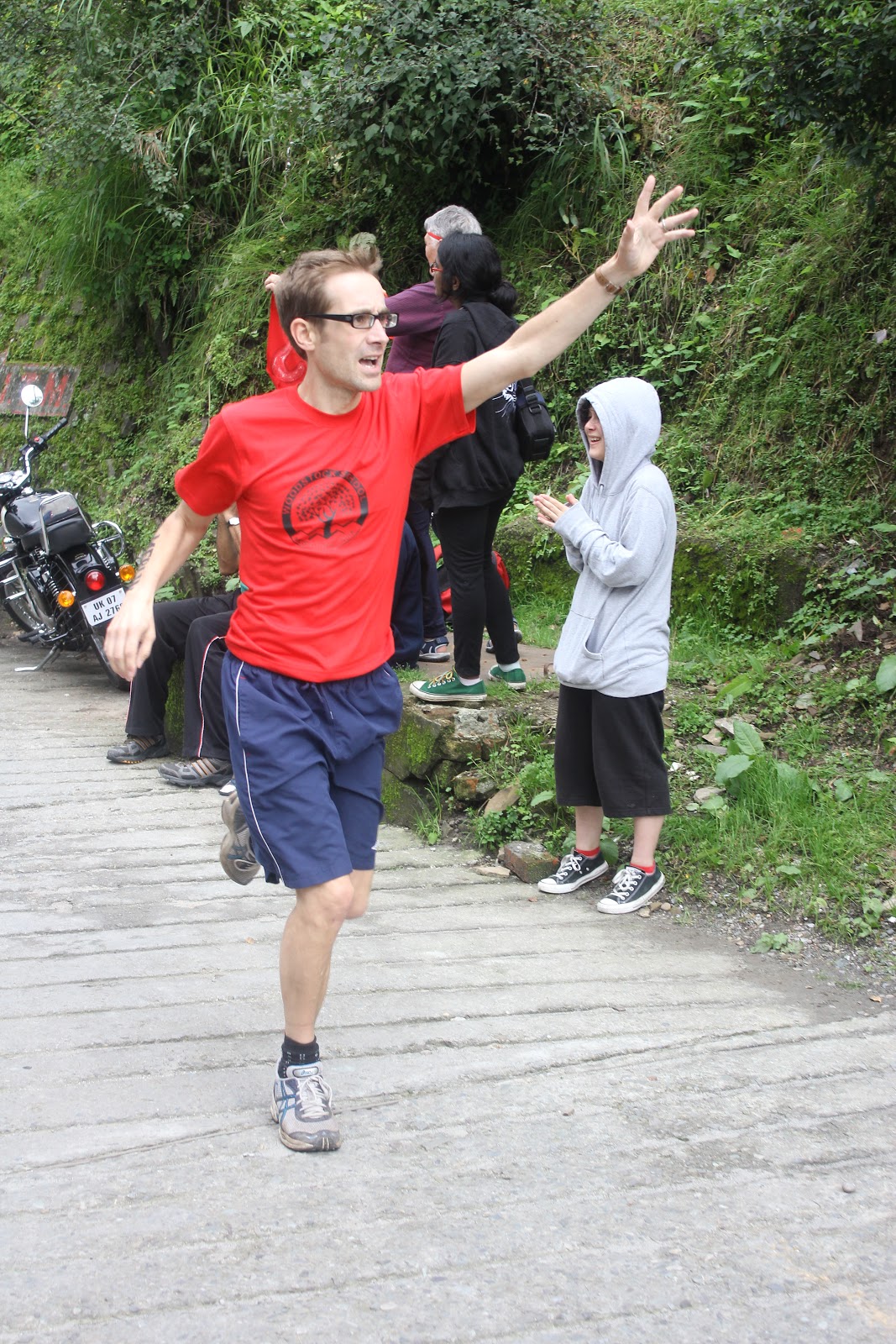
Cross country challenge: I've still got it!


Still got it: Ed running in the red of Merlins
It was the school interhouse cross country tournament earlier this month, and almost 20 years after my last cross country run, I was determined to take part and rack up some points for my house Merlins (a bird, the other houses are Condors and Eagles).

I decided to run with the Grade 9 boys, the year we are advisers to, so that meant a two-mile trek round the chukkars (circles) at the top of the hill here.

It's fair to say my wife didn't have the utmost confidence in me, particularly as my earlier attempt to run at altitude had ended with my lungs almost exploding.

It is really tough running at this altitude, and I did have to stop and walk a few times, but I was pleased to finish the course in just under 25 minutes.

Amazingly Merlins, who in recent years have underachieved in the sporting arena, won the entire tournament, so my efforts were not in vain.

Now I just have to decide whether to run the Mussoorie half marathon in November...if so I really better start training sharpish!


Wednesday, 1 August 2012

Landslides and the Monsoon

Workers inspect the damage after the landslide outside our house
Slip land-sliding away!

So we arrived back in Mussoorie a week ago (gosh I'm becoming Americanised by Woodstock starting sentences with so!). It is Monsoon season for the next couple of months, which effectively means we are living in a cloud, and it rains incessantly. Apparently though this is a very light Monsoon compared to previous years, and we have had some clear periods and even some sun. But it is still very damp, difficult to dry clothes, and miserable for sun worshippers (such as my wife). It also means there are more spiders, scorpions and leeches sharing our humble abode.

Talking of our house, the other night at about 5am we were awoken by a huge rumbling which seemed very close to our home. We thought it was strange but were too tired to go and investigate, so turned over and went back to sleep. The next morning we got up and found a group of men in our garden area (I use the term garden loosely). I groaned and went outside to complain, fearing more disturbances from builders who had plagued our lives last semester. I was politely requested to look at a large landslide which had occured, stopping just metres from our house. That shut me up pretty sharpish!

Last term a huge amount of earth was dumped in our garden to fill a hole, this was then saturated with the Monsoon rain. This earth was pushing against a holding wall which could not take the weight...hence the landslide. The good news is that noone was hurt, and our house has strong foundations and should be fine (famous last words). But as the photo below shows, it was a bit close for comfort!

The view from our window!

Not pret-a-porter

You know you are back in India when red-uniformed porters try and carry your luggage at railway stations. These guys have an irritating tendency to board a train just as it arrives at your destination thereby precluding all passengers from alighting. They then try and grab your suitcase and carry it for a fee. Getting on or off a train is already tricky as often the whole extended family of Indian passengers board a train to say goodbye, clogging up the corridor, even though they are not travelling. These porters do offer a useful service but will often try and charge foreigners an inflated fee. On this occasion I gave them a firm "nehi donyevard" ("no thanks") as we did not require their services, although my conscience was piqued when one of them opined: "If you people do not use us how will we survive?"

Indian bookworm

I am enjoying reading Indian novels and books on the country while being here. Anything by William Dalrymple is great, currently I am reading Kirsten The Age of Kali which is very informative. We were interested to read that the city of Lucknow used to be one of the cultural centres of India, but sadly has been in decline over the last 50 years. Some of the religious violence which has taken place in recent years is also shocking to read about.

I enjoyed White Tiger by Aravind Adiga and I'm loving A Fine Balance by Rohinton Mistry. Set in 1970s Mumbai during the Emergency period, when the Government ruled by decree, it paints an illuminating portrait of India as the four characters from different backgrounds struggle to survive in a modernising India. The book captures the ghastly injustice and violence of the caste system, the grim reality of life in a slum, and the values and priorities of Indian families. It is still remarkably pertinent to Indian life today, and I would heartily recommend it.

I also read One Hundred Splendid Suns by Khaled Hosseni, the follow up to the Kite Runner, but that is set in Afghanistan. It's a great, but somewhat depressing, read.

Power problems

Some of you have asked if we have been affected by the recent power cuts affecting most of northern India. Fortunately Woodstock has generators so we have not been had any blackouts, but the nearby town of Mussoorie has been. My brother-in-law pointed out that while many well-off Delhi dwellers were complaining their air conditioning was not working, hundreds of millions of Indians still do not have access to electricity. Makes you realise how lucky we are.

Highway On My Plate

Last term as part of my job I helped facilitate* the visit of a film crew from popular Indian food show Highway On My Plate to the school. You can watch the 20-minute programme online, it gives a great snapshot of Woodstock life and the beautiful campus, and if you watch carefully, you may spot me lurking in the background!

*I use this term ironically. Obviously in my job I also stovepipe out our key messages to our relevant stakeholders etc etc...

Thursday, 21 June 2012

Random observations from India

My first semester at Woodstock School in India is almost over. Here, in no particular order, are some observations on life in India.

Incessant car horns

As I write this every minute or so the peaceful mountain air is punctuated by the sound of a car hooting. This is because hooting is an inherent and normal part of driving in India, as normal as indicating or checking one's rear view mirror (although incidentally those driving disciplines don't get much of a look in here). Drivers basically use the horn as a warning to other drivers as they approach a bend: why bother slowing down when you can just "blow horn", words which emblazon many a truck. I'm always amazed there aren't more accidents on bends as one sees two cars or the numerous scooters approaching one another at breakneck speed, but somehow it seems to work out, and I've yet to see a crash.

Blow horn: Oh OK if you insist. A typical message on an Indian lorry.


Lack of personal space

Personal space as a concept doesn't seem to exist in India. This can be difficult for the westerner, particularly on a train journey, when playing Bollywood movie music at full volume in a crowded carriage is positively encouraged. Or if you try and sit on your own in a park people will come and sit right next to you. I guess many people here have grown up in large families in cramped homes, and personal space is not an option. I guess it highlights how cossetted some of us have become.

Hot work for coolies

Coolies are the men here who carry and transport stuff around on their backs. They deliever anything from shopping to fridges, which make them look like giant ants as they lug items much bigger than their body weight. They work extremely hard and often walk long distances with their heavy loads, which they tie round their heads to help ease the burden. What's depressing is the tip we sometimes give them for the delivery is probably larger than the sum they're paid to do this gruelling job.

Workmen watching on

It's felt like we've lived on a building site this semester as work has gone on for months in our garden. Most days we have a team of workmen turn up to shift earth from one side of the house to the other; then the next day they come back and move it back to where it was before. What I've noticed is that while one or two guys do some work, there will always be another two, three, four or five men just looking on (see photo below for example). This seems to be the case in the majority of labouring situations I've seen. Why work when you can watch on?

Workmen ratio of 2:5 of those working:sitting around


Doesn't matter if you're brown or white

There are adverts everywhere for skin whitening cream; it seems many Indians want to be whiter as lighter skin is considered more attractive. Meanwhile us white folk always want to be browner. Funny eh, and somewhat tragic none of us are happy in the skin we are in.

Cheeky monkeys

I rang my sister the other day and she was paying a fortune to take her family to Colchester Zoo. Here we don't need to pay for the wildlife, most days we see rhesus and langur monkeys on the way in to work. They are often very cheeky monkeys, trying to steal food and even swimming in the school pool. Contrary to my wife's advice, I try and stand up to the monkeys if they are being aggressive, insisting we assert the natural order of man versus beast. So far this policy seems to be working, and hopefully I won't get beaten up by a marauding monkey anytime soon.

I'm heading back to Blighty soon so this'll be my last blog for a while. All the very best, look after yourselves, and take great care. Edster

Monday, 7 May 2012

India's uneven platforms

Many of you will know I'm a bit of a trainspotter, so I've enjoyed travelling round India on its excellent and efficient railway system.

My wife Kirsten and I took the sleeper train from Mumbai to Goa for our honeymoon which was a very cheap alternative to flying, and gives you a far better snapshot of Indian life than taking to the skies.

As you travel through both cities and rural areas there is never a dull moment, as you see people (often women) working in the fields, kids playing cricket on any scrap of open space, or even in the middle of a busy road, and others going about their daily ablutions (the luxury of privacy is not an option for them).


Indian railway stations are a microcosm of society. There are people everywhere, many sleeping on the platforms waiting hours for a connection. But many sleeping there because that is their home. Railway platforms are a magnet for the crippled and disabled in Indian society. This makes waiting at a station an uncomfortable experience for the western traveller.

You are frequently approached by the poor and lame, begging for money or food. Sometimes there are men walking on their hands in a scrunched up crouching position because they cannot use their legs. They also live on the station, rejected by a system where they cannot afford healthcare. Seeing people like this makes you want to cry.

This is when you face the difficult decisions on how to respond. Do I engage with the person, compared to whom I have riches beyond their imagination? Do I ignore them and not make eye contact, because I'm fed up with being hassled in India?


It's a difficult dilemma for every westerner in India. We had an excellent devotion at Woodstock School recently, where former teacher Andy Matheson, who is international director for Christian charity Oasis, and has a wealth of experience of working with the urban poor in India, urged us to try and personalise the situation. Ask the person their name, engage them in a conversation, and try and communicate Christ's love through a chat. This could be the only positive interaction they have had in days.

But I won't say I have always been able to do this, after long, tiring train journeys, the default position is often to try and ignore the immense poverty that is all around. It's something which challenges one's philosophical and spiritual convictions.

I try and have a bunch of bananas with me when travelling, as these serve as a useful thing to give out. But I realise this will not solve this person's long term predicament.

So even for an avid trainspotter like me, it's not always a laugh a minute travelling around this amazing and diverse country on the train.